
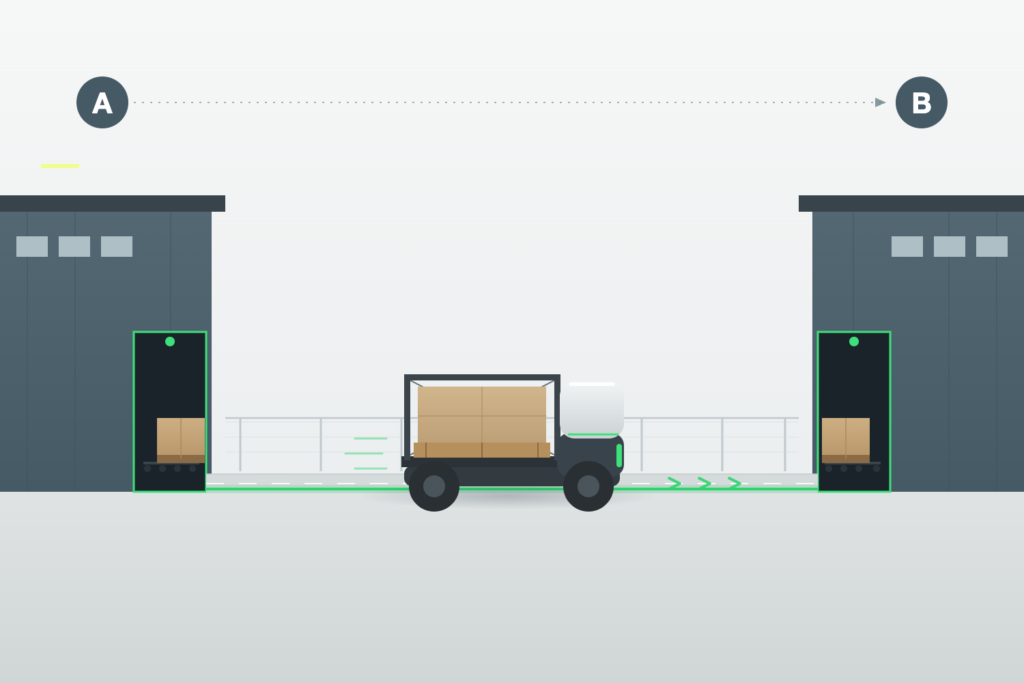
Most industrial sites today have the same structural gap. Inside each building, automation is mature and performing well — palletizers, AS/RS, AMRs, conveyors. Between buildings, pallet movement still depends on forklifts, manual scheduling, and whoever showed up that shift. That gap is not a minor inefficiency. It is the reason end-to-end automation has remained out of reach for most sites, regardless of how much has been invested in individual buildings.
Cross-building automation is the category that closes it.
What cross-building automation is
Cross-building automation is the automated transport of pallets between separate buildings within a single facility or industrial campus — without manual handling or human intervention in the outdoor space.
It operates as the continuity layer between automation systems that currently stop at the building exit. A pallet exits production via conveyor, palletizer, or AMR handover, transfers to a dedicated automated transport system, travels to the destination building, and integrates into the receiving building’s automation stack. No forklift. No operator. No manual step at any transfer point.
The outcome this creates — when the system connects all four layers of the automation stack — is what the industry calls automated source-to-sink pallet transport on private industrial premises: a continuous flow from the point where a pallet is produced to the point where it is consumed or dispatched, with no manual intervention anywhere in the chain.
The system connects to existing WMS, MES, or ERP platforms via standard API. Every pallet movement becomes a traceable, schedulable event. The outdoor transport layer, which has historically been invisible to planning systems, becomes part of the site’s operational data model.
Why the gap has persisted
Indoor automation technologies — conveyors, AMRs, AGVs, AS/RS systems — are designed for controlled indoor environments. They stop at the building exit not because vendors failed to design outdoor versions, but because outdoor operation is a fundamentally different engineering problem: weather exposure, variable terrain, long distances, road crossings, mixed-traffic conditions.
Every time a pallet reaches the outbound door of a building, automated flow breaks. The forklift picks up where the conveyor ends and operates on a different logic: available operator, available vehicle, available route, variable traffic.
This has persisted for two reasons. First, cross-building transport has historically been classified as an operational cost — owned by neither production nor logistics, assigned to neither department’s KPI. No cycle time target. No dashboard. No visibility into the variability cascading into both buildings every shift. Second, no standardized commercial category existed to solve it. Bespoke custom projects existed for large individual facilities — expensive, slow, and impossible to replicate. That condition has changed.
Where it fits in the automation stack
End-to-end automation on an industrial site requires four functional layers to operate without interruption.
| Layer | Function | Automation level |
| Layer 1 | Inside-building automation: production lines, palletizers, conveyors, AMRs, AS/RS | 80–95% |
| Layer 2 | Loading/unloading dock integration — handover between indoor and outdoor systems | Partially addressed |
| Layer 3 | Between-building transport — outdoor pallet movement building to building | <5% — THE GAP |
| Layer 4 | Receiving dock integration at the destination building | Partially addressed |
Cross-building automation is engineered specifically for Layer 3. It does not compete with the indoor stack. It extends automated flow across the gap that interrupts it. The consequence of a missing Layer 3 is that Layers 1, 2, and 4 cannot deliver their full designed performance — indoor automation is only as effective as the flow it receives.
How the system operates
At the dispatch building, a pallet exits the indoor system through a defined handover point — palletizer, conveyor end, or AMR drop-off. The automated loading interface accepts the pallet and initiates transport.
On the route, a shuttle carries the pallet along a pre-configured closed lane on private premises — no public road interaction, no open-road regulatory requirement. Routes can be configured above-ground along building perimeters, underground beneath road crossings, or as a hybrid. Intelligence is distributed to the lane infrastructure rather than concentrated in the vehicle — which keeps vehicle complexity and cost low.
At the receiving building, the pallet transfers automatically to the indoor system — directly into the inbound conveyor, AS/RS interface, or AMR pickup zone. Fleet management and scheduling runs continuously, synchronizing dispatch, buffer management, and mission prioritization with the site’s WMS or MES in real time.
The system supports both fully automated loading (upstream equipment feeds pallets directly) and independent loading (pallets arrive from any source — forklifts, manual pallet jacks — and the system takes over from there). Independent loading creates a clear adoption path for sites not yet fully automated indoors.
Operational impact — the measurable improvements
Cycle time and throughput
Forklift-based outdoor transport typically operates with cycle time variability of 30 to 50 percent above the theoretical minimum, driven by shift changes, scheduling gaps, and traffic. Automated transport runs at a consistent defined cycle time. Sites with high throughput requirements typically measure 10 to 25 percent improvement in overall line utilization after deployment — not because indoor machines changed, but because they now receive consistent flow.
Labor
A single cross-building route with three-shift coverage and redundancy provisions typically requires four to five operators. Annual labor cost per route: €180,000 to €275,000.
Safety
Outdoor forklift operations generate the majority of vehicle-pedestrian conflict risk on most industrial campuses. Removing forklifts from outdoor paths eliminates this risk class through physical separation — not through procedure or signage.
ROI and payback
For sites moving 200 or more pallets per day between buildings, payback on a qualifying deployment typically falls between 1.4 and 2 years.
The ecoro reference case: a corrugated packaging manufacturer in DACH, 300 pallets per day, two buildings, 180-meter route. Annual savings: €138,500. Payback: 1.4 years. OPEX reduction: 66 percent.
What qualifies a site
- Pallet volumes above 200 per day moving between buildings
- Distances between buildings of 50 to 600 meters
- Existing indoor automation already deployed (palletizers, conveyors, AMRs, or AS/RS)
- Operations running across two or more shifts
- Private premises — no public road required between buildings
The category distinction
Cross-building automation occupies a gap that no existing category addresses. Indoor automation vendors are optimized for controlled indoor environments. Their products cannot operate outdoors. Forklift and yard equipment provides outdoor flexibility, but at a cost and operational variability that is incompatible with modern automated production. Bespoke outdoor automation projects — large outdoor AGVs, underground tunnel installations — have been commissioned by individual large industrial facilities. These are engineering-intensive, capital-heavy, and site-specific. They are not a scalable commercial category.
Cross-building automation, as a commercial category, is standardized in components, configurable for different site layouts, and engineered to integrate with existing indoor systems through defined interfaces. It closes the Layer 3 gap without requiring redesign of anything that already works.
References
✓ [1] ERI SalaryExpert, Forklift Operator Salary in Germany (2026)
✓ [2] BMH Inc., Forklift Total Cost of Ownership Guide (2024)
✓ [3] AGV Network / Inovatica AGV, AGV ROI (2025)
? [4] EU forklift safety statistics — confirm primary source URL (EU-OSHA or European Commission) before publishing