
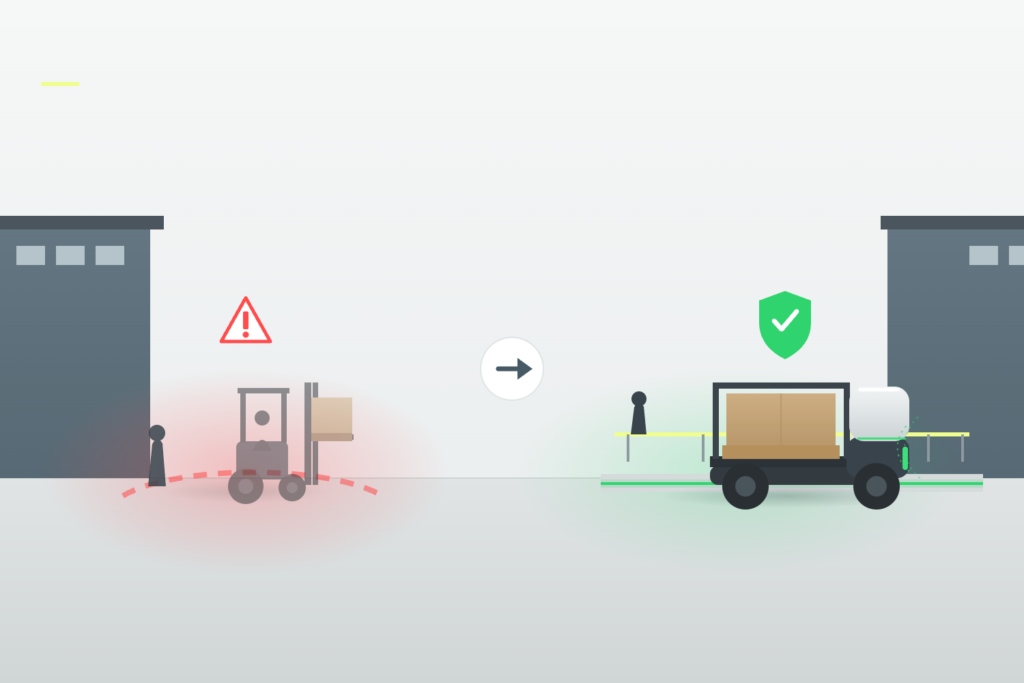
Forklifts were not designed for the job they are doing on most industrial campuses.
They were engineered for short-range, high-variability indoor handling — picking, stacking, and moving loads within a defined indoor environment. The outdoor cross-building transport role they have inherited — long stretches across open yards, in all weather, at high frequency, alongside pedestrians and delivery vehicles — is a different operational problem entirely.
That mismatch has consequences. Not primarily financial ones. Safety ones.
Outdoor forklift operations between buildings generate the highest-density vehicle-pedestrian conflict conditions on most industrial sites. Blind corners at building exits, weather-impaired visibility, driver fatigue across multi-shift schedules, and traffic peaks during shift changes create an exposure profile that no indoor safety programme fully addresses — because the risk is outside, in a zone with less structured oversight than the indoor environment.
EU-level data consistently identifies forklifts as the primary source of fatal and serious injuries in industrial logistics outdoor environments.
Why outdoor forklift operations carry a different risk profile
Indoor forklift operations are governed by defined traffic management — marked lanes, speed limits, pedestrian exclusion zones, and controlled entry points. These controls are imperfect, but they are established, audited, and continuously refined.
Outdoor cross-building transport typically operates under looser conditions. Paths are shared with foot traffic, delivery vehicles, and maintenance teams. Loading bay approaches concentrate forklift and pedestrian movement in the same narrow zones. Outdoor surfaces change with weather. Shift change periods create traffic peaks that indoor traffic management does not account for.
Most safety managers know this. The gap between knowing and resolving it has historically been the absence of a practical alternative. That gap has closed. Cross-building automation — a dedicated automated pallet transport system operating on a closed lane within private premises — is the structural replacement for outdoor forklift transport. Not a supplementary safety measure. A complete substitution of the exposure.
Forklift-based transport vs. cross-building automation: what changes operationally
| Forklift-based outdoor transport | Cross-building automation |
| Outdoor weather exposure on every run | Weatherproof — rain, snow, heat, sub-zero |
| Variable cycle time (±30–50% typical) | Defined cycle time — consistent across all shifts |
| Operator-dependent scheduling | Fleet scheduling automated — no human dependency |
| Vehicle-pedestrian conflict zones in shared outdoor areas | Dedicated closed lane — pedestrians physically separated |
| Idling during shift changes and breaks | Continuous 24/7 operation — no shift gaps |
| Staging buffers required to absorb variability | Buffer management handled automatically by the system |
| Cost scales with volume and shift coverage | Fixed operational cost — does not scale with volume |
What replacing outdoor forklifts looks like in practice
Step 1: Map the actual outdoor pallet flow
Pallet volumes per hour, peak windows, travel distances, and current cycle times — captured as observed data, not assumed. In most facilities this data does not exist in clean form. The measured flow typically differs from what operations management believes it to be.
Step 2: Identify the handover points
Cross-building automation requires defined handover interfaces at both ends of the route. Sites not fully automated indoors can use an independent loading interface — the pallet is placed at the intake point by any means, and the automated system takes over from there. This makes the system accessible regardless of indoor automation maturity.
Step 3: Select the routing configuration
Above-ground routing runs along building perimeters and fence lines — fastest to install and easiest to inspect. Underground routing eliminates road crossings as a conflict zone. Hybrid configurations handle road crossings underground while running above-ground between buildings. No road reconstruction is required.
Step 4: Integrate with indoor systems
The fleet management software connects to existing WMS or MES platforms via standard API. Every pallet movement becomes a traceable, schedulable event. Integration typically takes 4 to 6 weeks during commissioning.
Step 5: Transition forklift operations
Full replacement of outdoor cross-building forklifts typically takes three to six months from system go-live. Forklifts are progressively reassigned from cross-building runs to remaining tasks during this period.
What changes when forklifts leave the outdoor route
- Near-miss incidents in the outdoor zone drop immediately — the vehicle-pedestrian conflict is physically removed, not managed
- The outdoor yard becomes predictable — controlled, scheduled flow replaces a variable managed by exception
- Indoor automation assets stabilize — consistent outdoor flow reduces output variance on connected lines
For the safety case specifically, the most important number is not the ROI. It is zero vehicle-pedestrian incidents on the automated route from day one of operation. That outcome does not depend on pallet volume and does not require a financial model to justify.
The cost-reduction case runs alongside it. For most sites moving 200 or more pallets per day on a single route, payback on the system investment typically runs between 1.4 and 2 years.
References
✓ [1] AGV Network / Inovatica AGV, AGV ROI (2025)
? [2] EU forklift safety statistics — confirm primary source URL (EU-OSHA or European Commission) before publishing. This is the most important outstanding data task across all articles.