
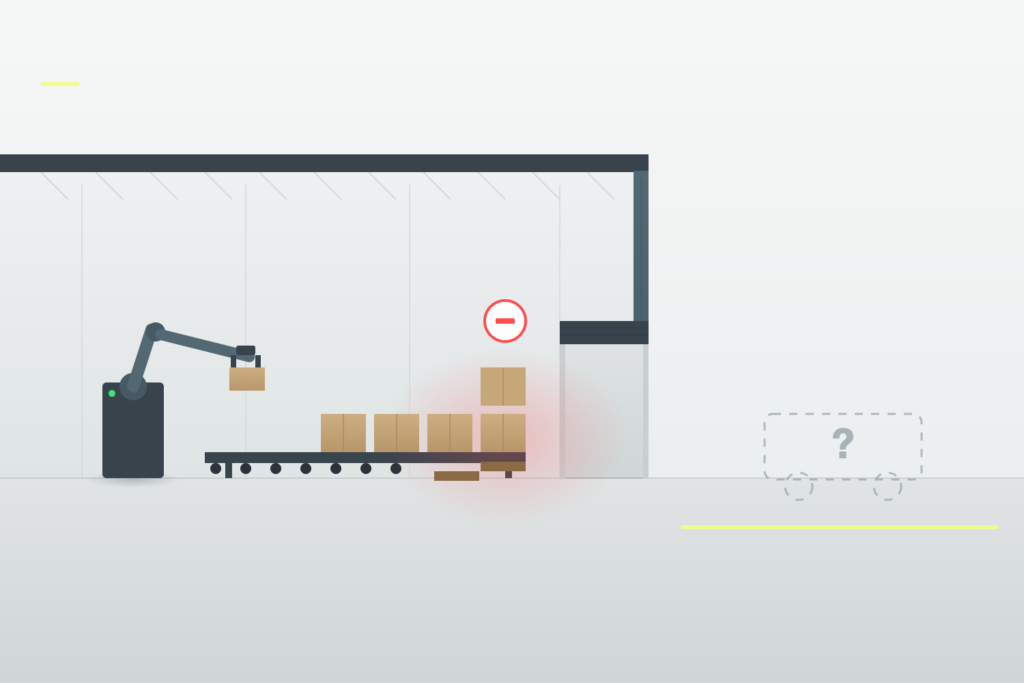
The problem is outside your building.
When a palletizer drops below its rated output, the investigation starts at the palletizer. When an AS/RS runs below capacity, engineers look at the crane logic. When AMRs slow down, the software team reviews mission scheduling.
The real cause is often outside the building entirely.
Indoor automation operates in a system. Every piece of equipment is designed to perform at a defined cycle rate. That performance depends on one condition: stable, predictable flow at every handover point. When outbound pallets stack up because there is no outdoor transport to collect them, or when inbound materials arrive late because a forklift missed its window, every connected asset downstream absorbs the disruption. Throughput loss on automated lines is frequently not a machine problem. It is a flow problem — and the flow breaks between buildings.
Four failure patterns that repeat across sites
Palletizers and conveyors back up
When a forklift arrives late to collect finished pallets, the conveyor upstream has nowhere to send them. Pallets stack. Workers intervene manually. During that window, the palletizer either stops or runs below pace. Sites with this pattern regularly lose 20 to 30 minutes of productive output per shift — not because the palletizer failed, but because outdoor transport was late.
AMRs compensate for the wrong problem
AMRs are designed to handle defined indoor transport missions. When outdoor flow collapses, AMRs are diverted to compensate — picking up pallets that forklifts failed to collect, waiting at loading points while outdoor operations catch up, or rerouting to avoid backlogged zones. Every mission an AMR handles outside its designed scope is throughput capacity diverted from its intended function.
AS/RS systems lose inbound rhythm
An AS/RS operates efficiently when inbound flow is consistent. Outdoor delays create inbound queues that the crane cannot process at nominal speed. The downstream effect is storage sequencing problems, longer cycle times, and dispatch cycles that fall out of alignment with production schedules. Operators often attribute this to software or crane performance. The root cause is outdoor transport variability feeding an inconsistent inbound stream.
Changeovers extend unpredictably
Changeovers require the right materials in the right place at the right time. Outdoor delays during changeover windows extend changeover duration directly. The affected takt time rarely recovers fully within the same shift.
Measuring the wrong assets
When throughput is below target, the instinct is to look at utilization rates on the highest-value assets — the AS/RS, the palletizer line, the AMR fleet. These assets are monitored. They produce data. Forklift operations between buildings typically produce very little data. Cycle times are rarely tracked. Deviation from schedule is not logged.
A facility running a €3 million AS/RS system at 78 percent utilization because outdoor flow is inconsistent is not experiencing an AS/RS problem. It is experiencing an automation gap problem. The distinction matters because the interventions are completely different. Improving AS/RS software or upgrading crane firmware will not fix a problem caused by outdoor variability. The correct intervention is closing the gap between buildings — stabilizing the flow that feeds and receives from indoor systems.
What improving throughput with cross-building automation actually looks like
- Indoor assets operate at their designed utilization rate — sites that have deployed cross-building automation typically measure throughput improvements of 10 to 25 percent on affected lines. Not because the indoor machines changed, but because they receive consistent flow.
- Takt time extends across the facility — production scheduling, pallet movement timing, and warehouse sequencing can synchronize into a single operational rhythm.
- Changeover impact drops — with outdoor transport on a defined schedule, materials arrive at changeover windows predictably. The uncontrolled variable that extends changeovers is removed.
- Software systems recover predictive accuracy — when cycle times stabilize, planning systems can operate on actual data rather than padded estimates. IT teams on sites that have closed the automation gap consistently report a reduction in reactive re-planning and exception handling.
The diagnostic question
If throughput on an automated line is below target and the investigation has focused on indoor equipment without resolution, the outdoor transport layer is the next diagnostic step.
The question to answer: what is the actual cycle time variability of outdoor pallet transport between buildings, and how does that variability correlate with throughput deviations on connected indoor assets? Sites that have measured this find the correlation clearly — the outdoor variability appears directly in indoor performance data: cycle time deviations, downtime logs, buffer overflow events.
Once the correlation is established, the financial case for closing the automation gap becomes straightforward. The ROI is not a new capability — it is the utilization recovery on automation assets that are already installed and already paid for.