
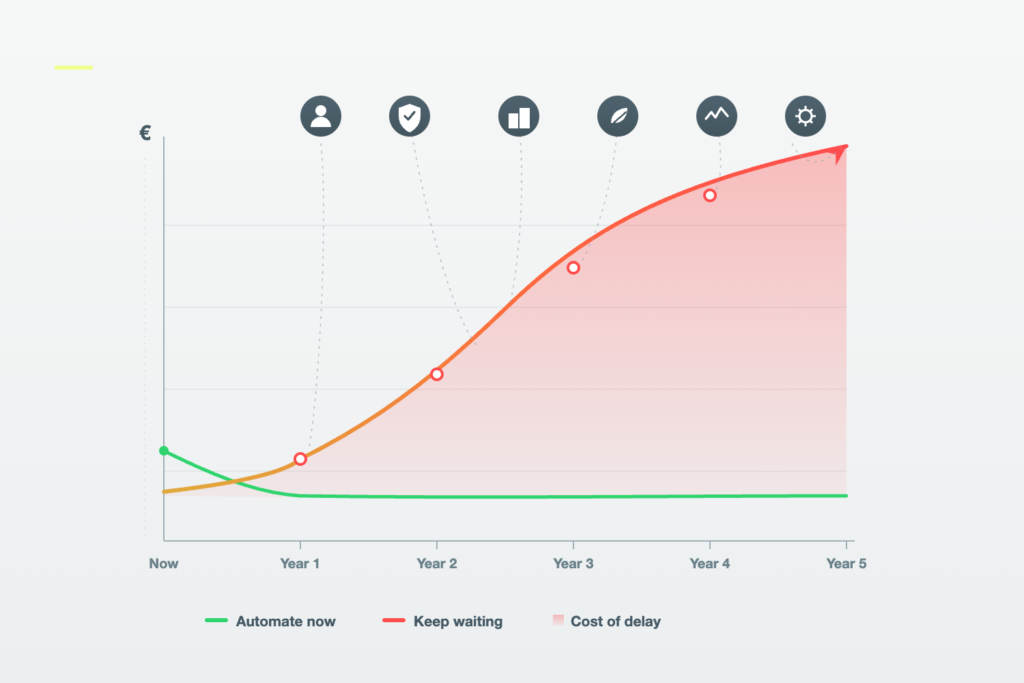
The decision most sites keep deferring
If you run a multi-building site, you already know the part of the operation this is about. The pallets that cross the yard between buildings, in the open air. Forklifts and yard trucks carry them. Drivers who don’t always show up carry them. When it rains, your throughput carries the cost.
You have almost certainly looked at automating that stretch. And you have almost certainly set it aside — not because the case was weak, but because it competed with everything else for capital, and there was always a reason to revisit it next year.
Here is what’s is easy to miss from inside the budgeting cycle: the reasons to automate that space are not holding steady while you wait. They are compounding. Six separate pressures push on the same stretch of your operation at once, and because each one lands on a different line — labour, safety, throughput, energy, real estate, capital — no single owner ever sees them add up. This puts them on one page.
THE REFRAME
You are not weighing one automation project against a stable baseline. You are weighing it against a baseline that gets more expensive every year it stays manual.
The six pressures, and why they compound
On its own, none of these would force a decision. Moving together, and all in the same direction, they change the arithmetic of waiting.
Why the cost keeps rising instead of holding
There is a structural reason this stretch of your operation gets more expensive rather than cheaper over time — and it is worth naming precisely, because it is the same reason it stays unfixed.
Inside your buildings, movement is measured. Every line has a cycle time, an owner, a number on a dashboard. The moment a pallet leaves the building, it enters a space that belongs to no one’s KPI. It is not production. It is not warehousing. It is “the yard” — an operational cost absorbed into overhead, reviewed rarely, owned by no one.
This is what the industry calls the automation gap between buildings: not a software problem, but a physical one. The systems that automate your indoor operation — conveyors, AMRs, AS/RS — were never built to cross the building boundary. They stop at the door. So the one stretch of your material flow that no automation category was designed for is also the one stretch no one is accountable for improving. Unowned cost does not fall on its own. It drifts upward with labour, with volume, with every pressure above — quietly, because nothing on your dashboard is watching it.
The cost of delay — made specific
Abstract pressure is easy to defer, so here is what it looks like as a number on one representative route.
Take a single high-use outdoor route: three shifts, roughly 350 pallets a day, about 400 metres between buildings. The fully loaded cost of moving those pallets by forklift — operators across shifts, fuel and maintenance, supervision, and the throughput lost to variability — lands in the range of €300,000 to €350,000 a year, for one route.
That is not a one-time gap. It recurs every year the route stays manual, and it climbs with each of the six pressures above. A year of deferral is not a year of holding position — it is a year of paying the rising baseline in full, with nothing recoverable at the end of it. recovery.
The point is not the precise number. It is the shape of the decision. A fixed-cost system replaces a variable cost that is rising. The longer that variable cost runs, the more the fixed system would have saved — which means the true cost of waiting is never zero. It is the saving you don’t capture, every year, plus the higher baseline you will eventually automate against.
What changes the math on your site
What makes this decision different from five years ago is that the space between your buildings finally has a system built specifically for it.
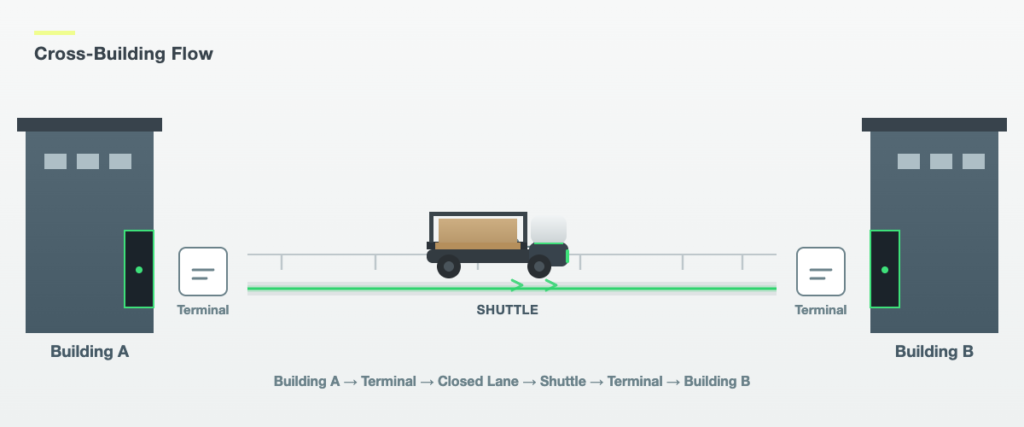
ecoro is not a generic AGV pointed at your yard, and it is not a forklift you no longer have to drive. It is a dedicated infrastructure layer for outdoor pallet transport on private premises: automated terminals at each building, a dedicated closed lane, low-cost electric shuttles, and centralised fleet control — working as one continuous flow from the building where a pallet is produced to the building where it is used.
Two things follow from that design, and both bear directly on the cost of waiting. Because the lane is closed and on your premises, the system sidesteps the open-road autonomy regulation that keeps yard-AGV projects in multi-year approval — it deploys in months, not years. And because the intelligence sits in the infrastructure rather than in every vehicle, the shuttles stay simple and inexpensive, which is what puts the payback inside two years rather than out of reach.
How to know if this applies to your site
The pressures compound on every multi-building site, but the economics turn decisively where the following are true:
- More than 200 pallets a day moving between buildings
- Distances of roughly 50 to 600 metres between them
- Indoor automation already in place in at least one building — palletisers, conveyors, AMRs, or AS/RS
- Operations running across two or more shifts
- Private premises, with no public road to cross between buildings
f that describes your site, the question is not whether the outdoor stretch is worth automating. It is how much the current baseline is costing you while it stays manual — and that is a number you can put in front of your own finance team this week.
Enter your pallet volume and route distance to get a conservative savings estimate in under 3 minutes.
Open calculator →REFERENCES AND DATA SOURCING
[1] ✓ EU-OSHA (European Agency for Safety and Health at Work), Workplace transport — keeping pedestrians and vehicles apart — oshwiki.osha.europa.eu
[2] ✓ European Union, Regulation (EU) 2023/1230 on machinery (applies from 20 January 2027; extends scope to autonomous and AI-enabled machinery) — eur-lex.europa.eu
[3] ✓ European Labour Authority / EURES, Labour shortages and surpluses in Europe(transport & storage: drivers and mobile-plant operators in shortage) — ela.europa.eu
[4] ✓ GHG Protocol, Corporate Accounting and Reporting Standard (Scope 1 direct emissions) — ghgprotocol.org
[5] ✓ Prologis Research, Persistent Supply Constraints Position Europe for Value Growth(European logistics land constraint and site densification) — prologis.com
[6] ✓ International Federation of Robotics, World Robotics 2025 (mobile robots for transport & logistics — adoption trend) — ifr.org
[7] ~ ecoro reference case — actual operational data from an identified customer site (corrugated-packaging manufacturer). Named case data released under customer permission.
[8] ~ ecoro single-route cost model and site assessments — the €300,000–350,000 range is a modelled baseline for the stated assumptions; site-specific figures are generated by the ecoro calculator from your inputs.