
Not every automated pallet transport system is built for the same problem.
Some are designed for indoor environments and have been adapted — imperfectly — for outdoor use. Some require open-road regulatory approval that takes years per market. Some have a vehicle cost profile that only works for very high-throughput sites. Some require fixed infrastructure modifications that make them unsuitable for sites with evolving layouts.
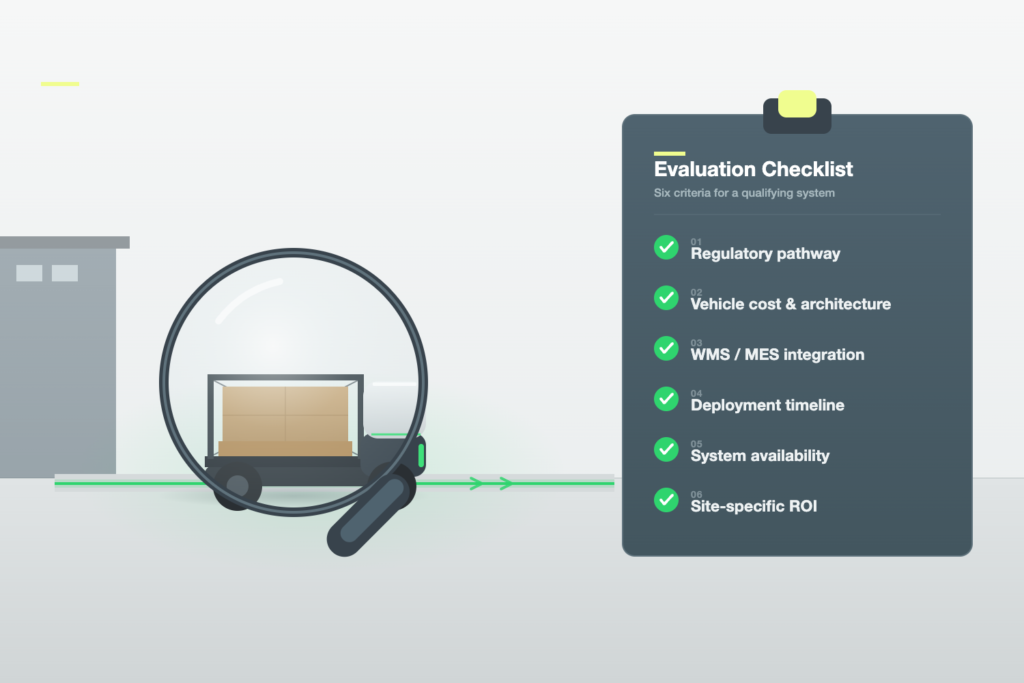
This article is for operations leaders who have already decided that outdoor pallet transport between buildings needs to be automated — and are now evaluating what a qualifying system actually looks like. Six evaluation criteria. For each: what to ask, what a good answer looks like, and what to flag for scrutiny.
Criterion 01 — Regulatory pathway: how fast can it actually deploy?
Outdoor autonomous vehicle systems designed for public roads require homologation — a regulatory approval process that runs three to seven years per market in most EU jurisdictions. A system going through this process cannot be deployed commercially while approval is pending.
Systems designed to operate exclusively on private premises on dedicated closed lanes avoid this entirely. They fall under the EC Machinery Directive rather than public-road AV regulation. No type approval. No jurisdiction-specific licensing.
- Ask: Where does the system operate? What regulatory framework governs deployment? What is the timeline from signed contract to go-live?
- Good answer: Private premises only. EC Machinery Directive. 4–6 months to deployment.
- Flag for scrutiny: Any system requiring type approval or open-road certification for your site configuration.
Criterion 02 — Vehicle cost and architecture: where is the intelligence?
Vehicle cost is a function of architecture, not just specification. Systems that distribute intelligence to the infrastructure — fixed sensors along the lane, with the vehicle as a simple, robust endpoint — achieve vehicle costs below €30,000. Systems that put a full autonomous sensor stack on each vehicle (LiDAR, radar, cameras, redundant compute) typically cost €200,000 to €300,000 per vehicle.
- Ask: What is the vehicle cost per unit? Where is the intelligence — in the vehicle or in the infrastructure?
- Good answer: Below €50,000 per vehicle. Intelligence distributed to infrastructure.
- Flag for scrutiny: Vehicle cost above €100,000. Full onboard sensor stack per vehicle.
Criterion 03 — WMS/MES integration: does it connect to what you already run?
A system that cannot communicate with your planning software creates a manual dispatch layer that defeats the operational benefits of automation. Cross-building automation should connect to existing WMS or MES platforms via standard API — REST or OPC-UA. Every pallet movement should become a traceable event visible in existing operational dashboards without a separate interface.
- Ask: What API does the system use for WMS/MES integration? Which platforms has it been integrated with? How long does integration take?
- Good answer: Standard REST or OPC-UA. Documented integrations with SAP, Oracle, or major WMS platforms. 4–6 weeks during commissioning.
- Flag for scrutiny: Proprietary integration protocols. Custom development requirements. Requirements to replace existing WMS.
Criterion 04 — Deployment timeline and operational disruption
The target deployment timeline for a qualified commercial cross-building automation system, from signed contract to go-live on a standard configuration, should be four to six months. Installation should not require shutting down cross-building operations. The system should install modularly around existing operations.
- Ask: What is the typical timeline from contract to go-live? Does installation require shutting down cross-building operations?
- Good answer: 4–6 months to go-live. Modular installation around existing operations. No shutdown required.
- Flag for scrutiny: Timelines beyond 12 months. Operational shutdowns during installation.
Criterion 05 — System availability: what happens when a shuttle fails?
An automated transport system that stops the cross-building route when one unit goes offline is not a production-grade solution. Redundancy needs to be built into the architecture at the fleet level. If one shuttle is offline, others continue operating the route. Diagnostics should be centralized — faults identified before they cause downtime. System availability target should be 99 percent or above.
- Ask: What is the target system availability? What happens operationally if one shuttle fails? What hypercare support is provided in the first months of operation?
- Good answer: 99%+ target availability. Fleet redundancy means single vehicle failure does not stop the route. Centralized fault detection. Defined hypercare program.
- Flag for scrutiny: No fleet redundancy. High dependence on per-vehicle diagnostics. No defined first-months support protocol.
Criterion 06 — The financial case: does it hold at your specific configuration?
Cross-building automation is the right decision at a well-matched site. It is not the right decision at every site. The evaluation should produce a site-specific number, not a generic claim. The inputs that determine payback: pallet volume per day, number of routes, route distance, current transport method, number of operating shifts, and current fully-loaded labor cost per operator.
- Ask: Can you model the ROI for my specific configuration with stated assumptions? What is the payback period at my volume and distance?
- Good answer: Site-specific model with stated assumptions. Payback period of 1.4 to 3 years for qualifying sites.
- Flag for scrutiny: Generic ROI claims without site-specific inputs. Unwillingness to state the assumption basis for any claimed savings figure.
Summary checklist
| Criterion | Evaluation question | Look for |
| 1 | Regulatory pathway | Private premises; EC Machinery Directive; 4–6 months to deployment |
| 2 | Vehicle cost and architecture | Below €50K/unit; intelligence in infrastructure not vehicle |
| 3 | WMS/MES integration | Standard API; documented integrations; 4–6 weeks commissioning |
| 4 | Deployment timeline | 4–6 months; modular installation; no operational shutdown |
| 5 | System availability | 99%+ target; fleet redundancy; centralized diagnostics |
| 6 | Site-specific ROI | Stated assumptions; 1.4–3 year payback on qualifying sites |
References
✓ [1] AGV Network / Inovatica AGV, AGV ROI (2025)
~ [2] Vehicle cost comparison for open-road AV systems: directionally consistent with McKinsey Global Institute and Roland Berger AV market reports. ACTION: Confirm a specific published citation before publishing Article 7.