🔊 UPDATE:

ecoro selected as 1 of 10 startups in EIT Urban Mobility Scale-up 2025.

The ecoro system

An integrated system built for one problem: moving pallets between buildings.

Not an AGV. Not a conveyor extension. A dedicated infrastructure layer —
terminals, closed lane, electric shuttles, fleet software — all working as one.

What ecoro is

Fully Automated Cross-Building Pallet Transport

ecoro is engineered to to close the automation gap between buildings from industrial sites to freight networks in the foreseeable future.

What ecoro is

Fully Automated Cross-Building Pallet Transport

ecoro is engineered to to close the automation gap between buildings from industrial sites to freight networks in the foreseeable future.

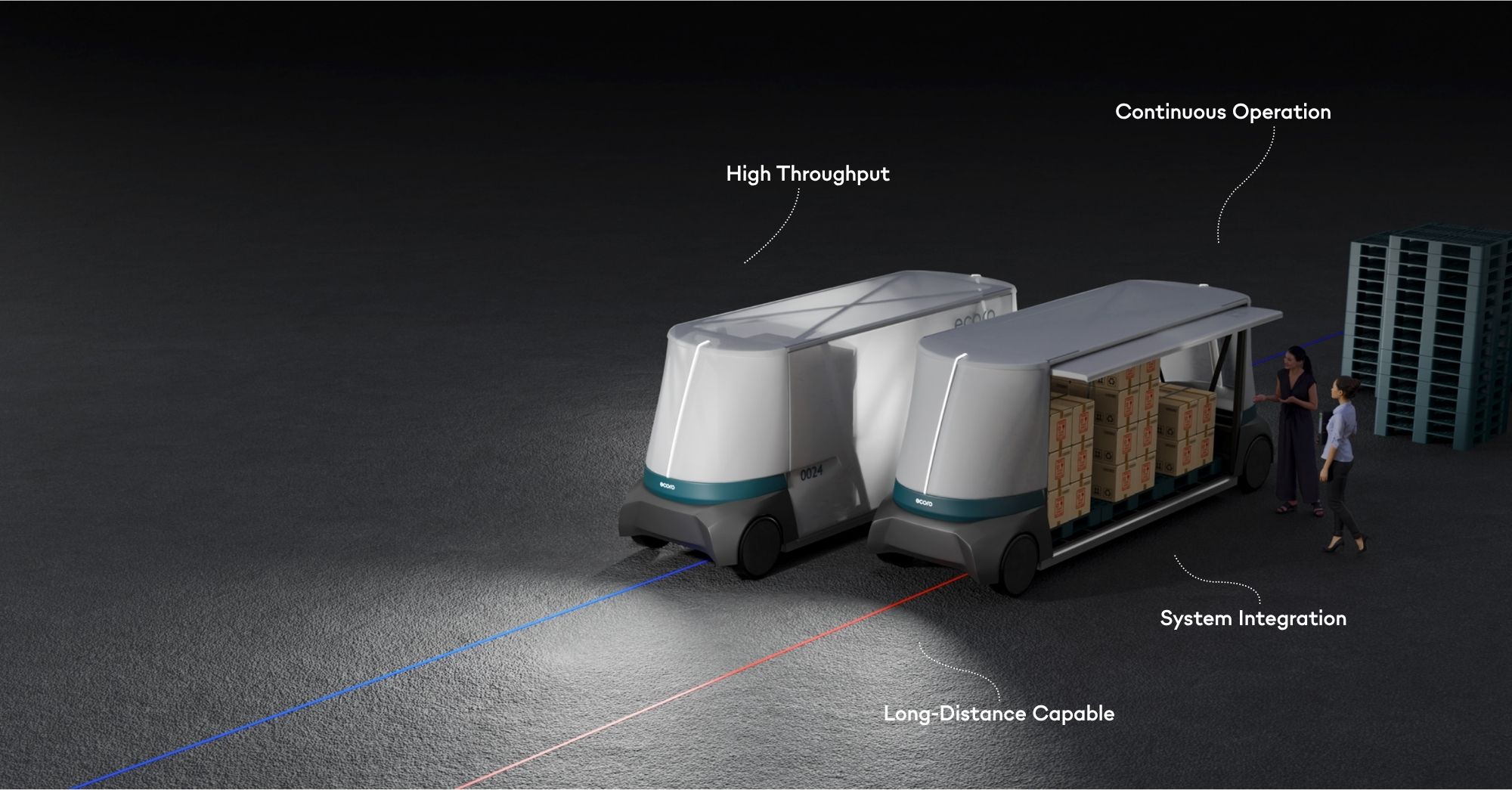
High Throughput

Up to 2.4 tonnes palletized payload per shuttle

Continuous Operation

Designed for 24/7 non-stop logistics throughput

System Integration

Built for/with automated terminals, WMS/ERP, and fleet control

Long-distance capable

Operates across industrial sites and regional routes
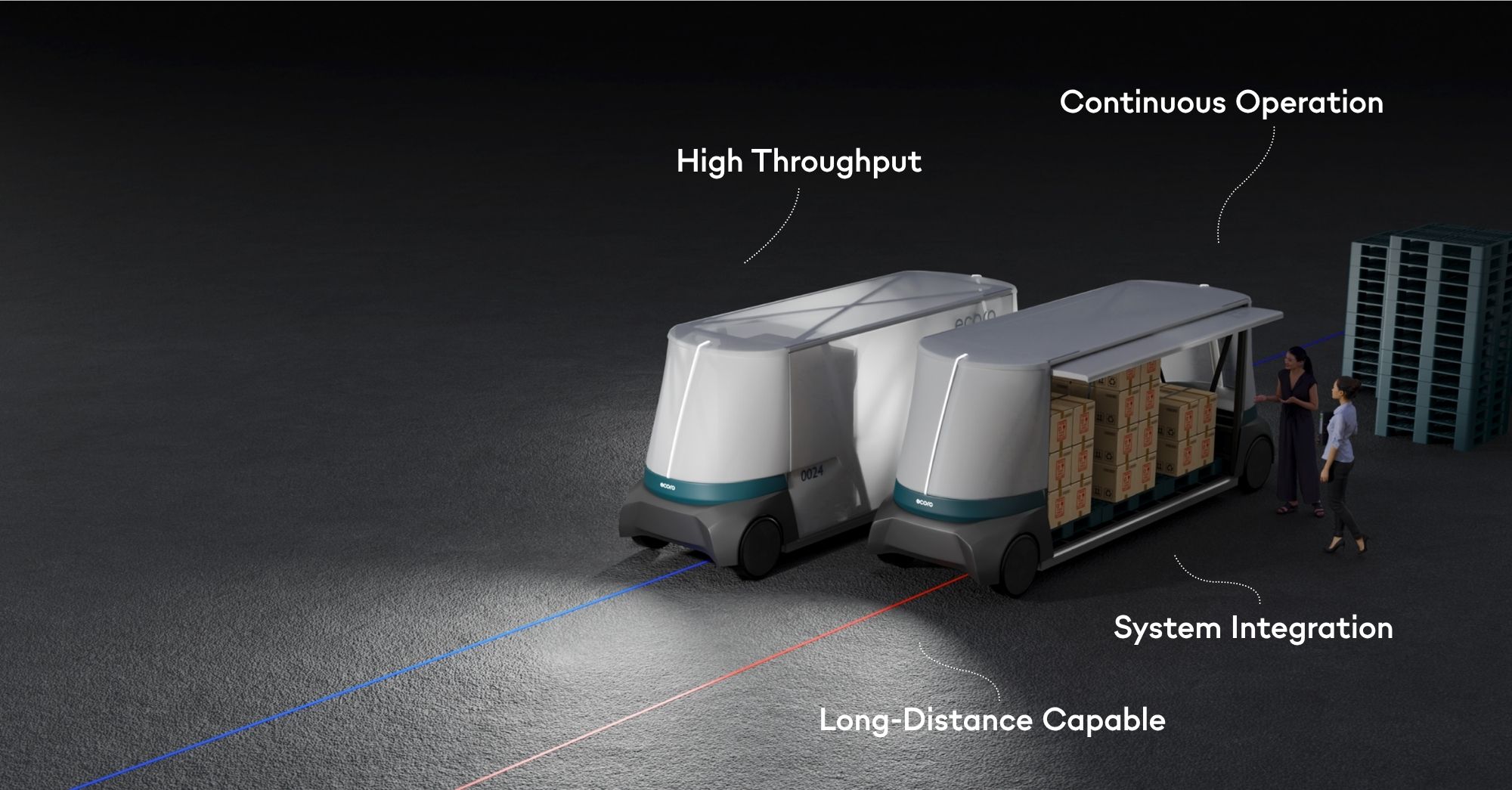
High Throughput

Up to 2.4 tonnes palletized payload per shuttle

Continuous Operation

Designed for 24/7 non-stop logistics throughput

System Integration

Built for/with automated terminals, WMS/ERP, and fleet control

Long-distance capable

Operates across industrial sites and regional routes
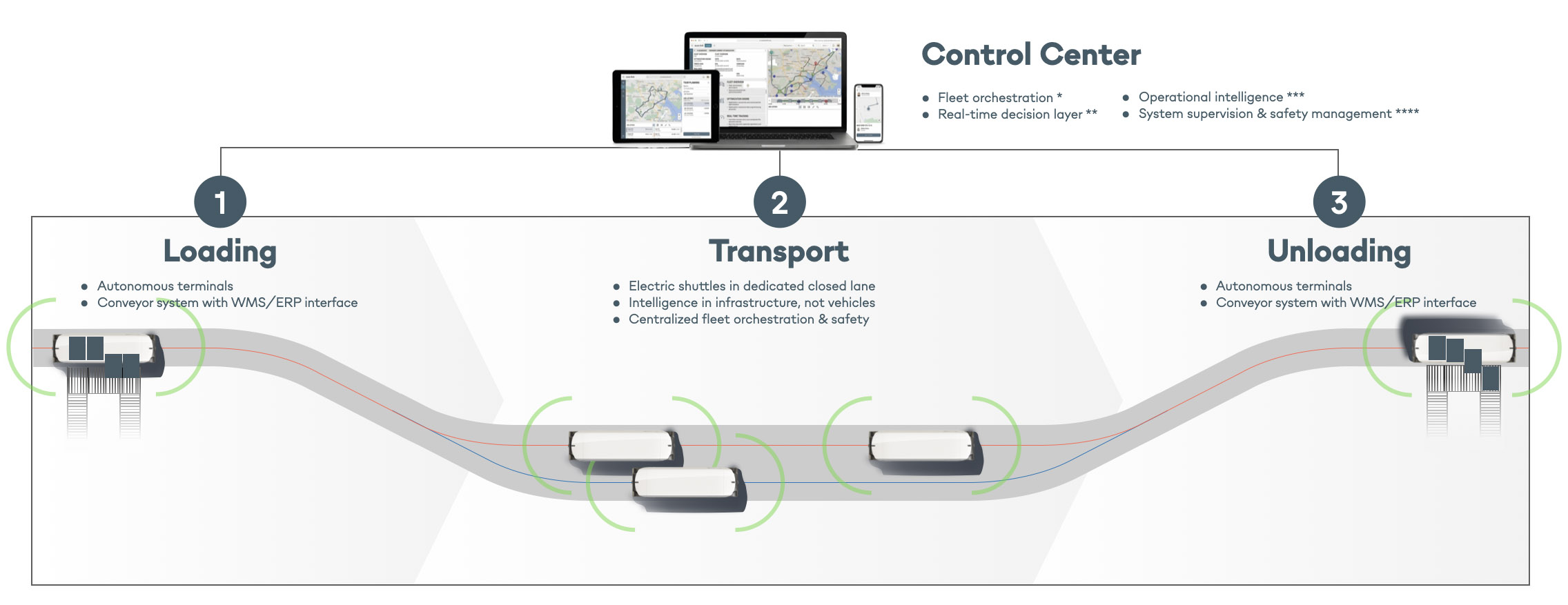
The ecosystem

Hardware. Software. Infrastructure. One System

The Closed-Lane Principle

Why ecoro deploys in months, not years.

Open-road autonomy waits 3–7 years for homologation in every market. ecoro runs only on closed lanes inside private premises — so it answers to machinery rules, not road law.

+ Tap any row to see why it changes the economics
ecoro closed laneOpen-road AV
On private premises, ecoro is governed by machinery rules — not public-road AV law. No type approval, and nothing to re-certify market by market.
Skipping homologation removes the multi-year regulatory queue. Deployment becomes an engineering timeline, not a legal one.
A closed, controlled environment allows a far simpler machine — the intelligence lives in the infrastructure, not in every shuttle.
Sensing and control sit in the lane and terminals, so each shuttle stays low-cost and simple to maintain across a growing fleet.
A dedicated lane has no pedestrians, cars or cyclists to negotiate — the hardest, most expensive part of open-road autonomy isn’t there.

This isn’t a workaround. It’s the design principle.

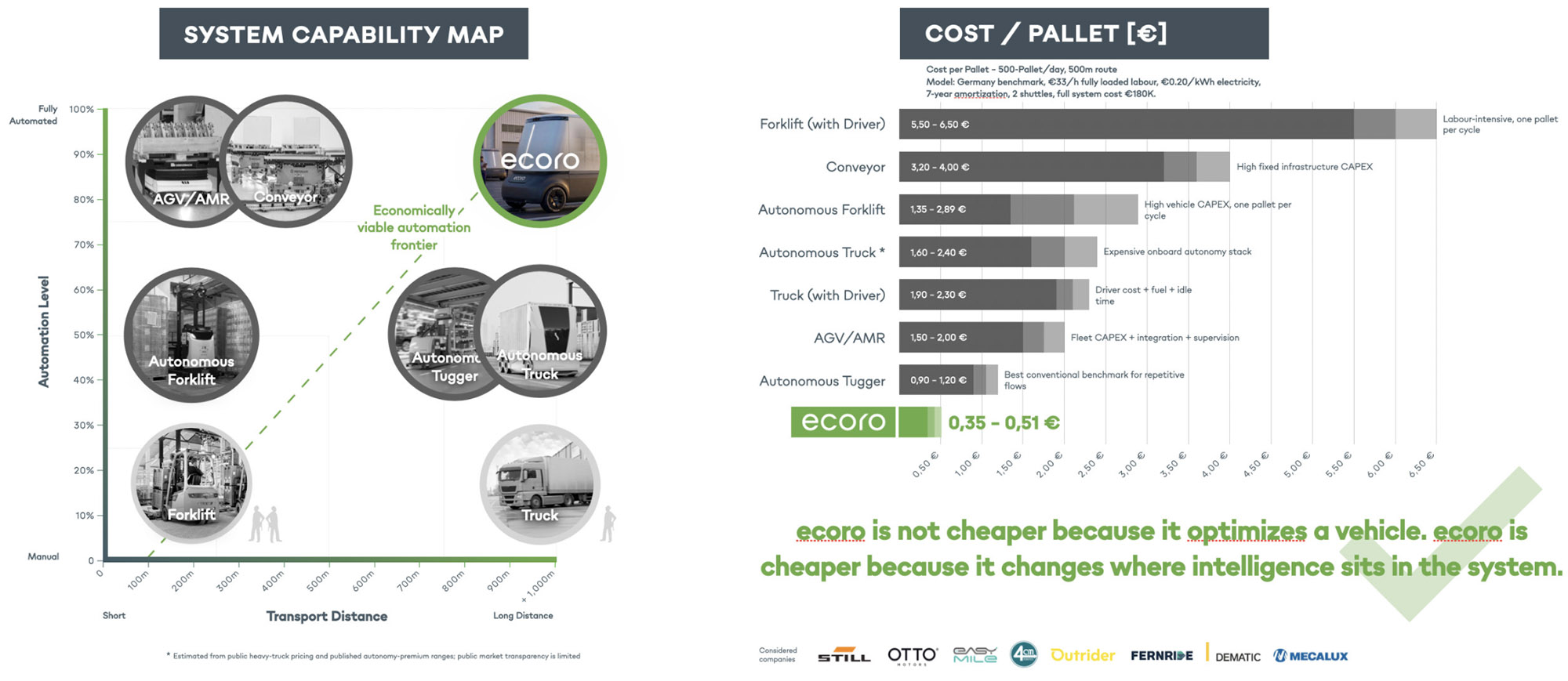
Cost per pallet

Lowest cost per pallet at scale.

Reference case

The numbers from a real site.

A corrugated packaging manufacturer in the DACH region. Two buildings. 300 pallets per day moving outdoors. A three-forklift operation replaced by the ecoro system.

All figures are actual operational data. Assumptions are stated. Use the calculator to model your own site.

Savings figures are site-specific. Actual results depend on pallet volume, current transport model, site layout, and labor costs. Every site receives a custom assessment before any commercial proposal.

€138,500

Annual savings

Includes labor, maintenance, insurance, and downtime cost reduction versus the three-forklift baseline.

1.4 yrs

CAPEX payback period

Full system cost recovered within 17 months at the reference site configuration. Finance-case ready.

66%

OPEX reduction

Total outdoor pallet transport operating cost reduction versus the forklift baseline.

3.7

FTEs removed from the route

Forklift operators redeployed to value-adding tasks. Zero redundancies required in the reference case.

€0.42

Cost per pallet at scale

Versus €1.20–2.40 per pallet with forklift transport. Decreases further as fleet scales.

Deployment Process

From signed contract to live system.

Phase 1 Site assessment & lane design

Full site survey, pallet flow mapping, route design, integration scoping, and system specification signed off.

Common Questions

What COOs ask before moving forward.

These are the questions we hear most from operations leaders evaluating ecoro. If yours is not here, the 20-minute site assessment answers it for your specific configuration.

Do we need to modify our buildings or existing infrastructure?

No structural building modifications are required. The terminals attach at building entries without requiring internal layout changes. The closed lane is installed on your outdoor premises. The software integrates with your existing WMS without replacing it.

Does the system work in rain, snow, and extreme temperatures?

The fleet is sized for redundancy — if one shuttle is offline, others continue operating the route. Infrastructure-level intelligence means faults are identified before they cause downtime. We target 99%+ system availability, with a defined hypercare protocol for the first six months of every deployment.

The fleet is sized for redundancy — if one shuttle is offline, others continue operating the route. Infrastructure-level intelligence means faults are identified before they cause downtime. We target 99%+ system availability, with a defined hypercare protocol for the first six months of every deployment.

ecoro operates under the EC Machinery Directive — not public-road AV regulation. CE marking covers the shuttle and infrastructure components. There is no type approval, no jurisdiction-specific licensing, and no homologation process. This is the regulatory advantage of the closed-lane architecture.

A standard two-shuttle system for a single route starts in the €150,000–300,000 CAPEX range depending on route length, terminal configuration, and integration requirements. Annual service contract is €30,000–50,000. The site assessment produces a site-specific commercial proposal — use the calculator for an initial estimate.

A single two-shuttle system handles 200–600 pallets per day depending on route distance and pallet cycle time. Multi-shuttle and multi-route configurations scale capacity further. The 200+ pallets/day threshold is the minimum for a strong business case — below this, the payback period extends beyond 2 years.

The closed lane operates with fixed infrastructure sensors that provide full situational awareness. The shuttle detects obstacles in real time and stops automatically — resuming when the path is clear. The system is designed and certified according to current safety standards and is approved for operation in environments where people are present.

In the reference case, three forklift operators were redeployed to value-adding tasks — no redundancies were required. Forklifts used exclusively on the automated route can be reallocated or returned if leased. The transition is phased to ensure operational continuity throughout.

Want to know what this means for your site?

No sales pressure. No commitment at this stage.
Just a clear picture of what automated outdoor pallet transport means for your site.

Your Estimated Cost savings with ecoro freight automation: